
A Sudoku Is One Big Whole!
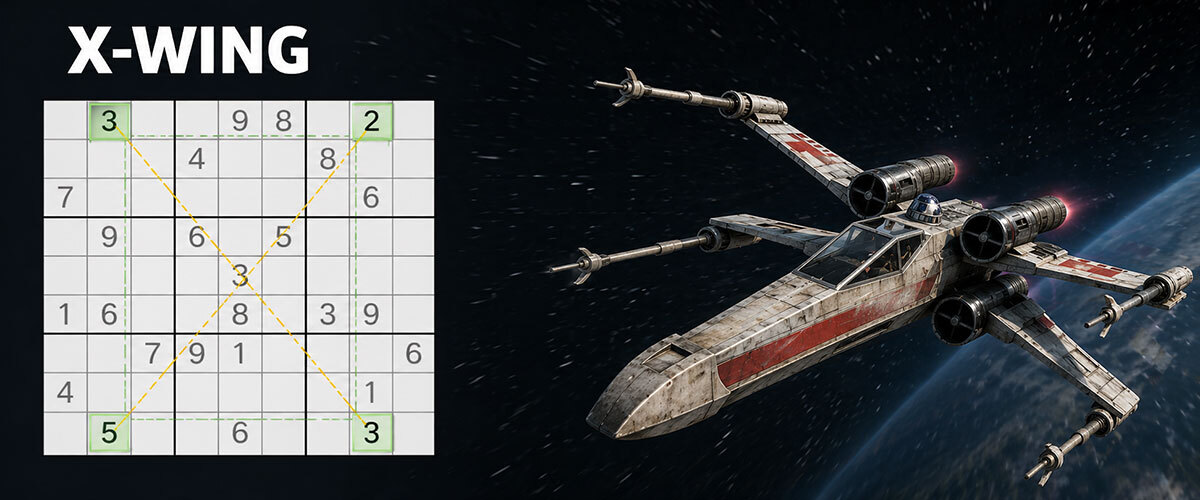
Sudoku is all about structures and connections. The further you progress in a puzzle, the clearer it becomes that many solutions are not found in individual cells, but in patterns that stretch across the entire grid. The X-Wing is often the first step into this world of advanced logic. But when two rows or columns are no longer enough to find new solutions, the pattern expands across additional units, and the strategy known as Swordfish has to step in. It is more complex and does not appear in puzzles all that often, but when a Swordfish comes into play, it can be incredibly effective. When it looks like a puzzle is lost, the Swordfish can still change everything.
Sudoku at Zaphira Games
Are you playing Sudoku online at Zaphira Games and unsure about a solution or strategy? Then click the pencil button to switch to notes mode. Here, you can test your ideas at your own pace, because even if a digit is wrong, it will not count toward your mistake total. Only when you switch back to play mode do things get serious again, and you need to make sure you enter only correct solutions into the grid.
The Basic Idea Behind Swordfish
Swordfish patterns mainly appear in hard Sudoku puzzles where the candidate lists become dense and hard to read, or where many cells are still empty. A Swordfish occurs when a specific candidate appears in three rows only in the same three columns, or, in the mirrored version, in three columns only in the same three rows. This structure resembles a larger, branching net that locks the candidate into exactly these nine possible positions. Behind it is clear logic. If the candidate can appear in each of the three rows only in these three columns, then all other instances of the same candidate in those columns must be ruled out. That makes Swordfish a natural extension of the X-Wing, just bigger, more complex, and even more powerful.
Practice Example: A Swordfish in Action
Imagine the number 4 appears in row 1 only in columns 2, 5, and 8. In row 5, the 4 also appears only in those three columns. And in row 9, the exact same pattern repeats. These three rows and three columns form a Swordfish. This means that in columns 2, 5, and 8, the 4 cannot appear in any other row. You remove the 4 from all other cells in those columns and trigger new logical steps. Often, this exact moment is the breakthrough in a hard puzzle.
Variations and Related Techniques
Swordfish is one of the Sudoku techniques based on symmetrical candidate patterns. The X-Wing is the simplest form, Swordfish is the next level, and Jellyfish expands the principle to four rows or columns. All of these techniques follow the same basic idea: A candidate forms a consistent pattern across several units, making it possible to eliminate candidates logically. Once you’ve mastered the X-Wing, you can start working with Swordfish. It is the next step on your journey to becoming a Sudoku pro.
Common Mistakes and Pitfalls
Sometimes players think they see a Swordfish where there actually isn’t one. This happens because some candidate patterns look confusingly similar to a Swordfish pattern. These false patterns often come from incomplete candidate lists in your notes. A true Swordfish requires the three rows to occupy exactly the same three columns, with no deviation. If you consistently enter all candidates and check the structure carefully, you’ll be able to recognize a Swordfish with confidence and use it reliably.
Sudoku at Zaphira Games
Precision Through Pattern Recognition
The Swordfish technique shows just how powerful and deep Sudoku logic becomes when you think beyond individual cells. Three rows, three columns, and one candidate moving within a precise pattern, that’s all it takes to get a stuck puzzle moving again. Once you learn to recognize this structure, you gain a tool for your Sudoku repertoire that gives you a decisive advantage in hard puzzles and can turn a looming defeat into the exact opposite.