
What Is an X-Wing?
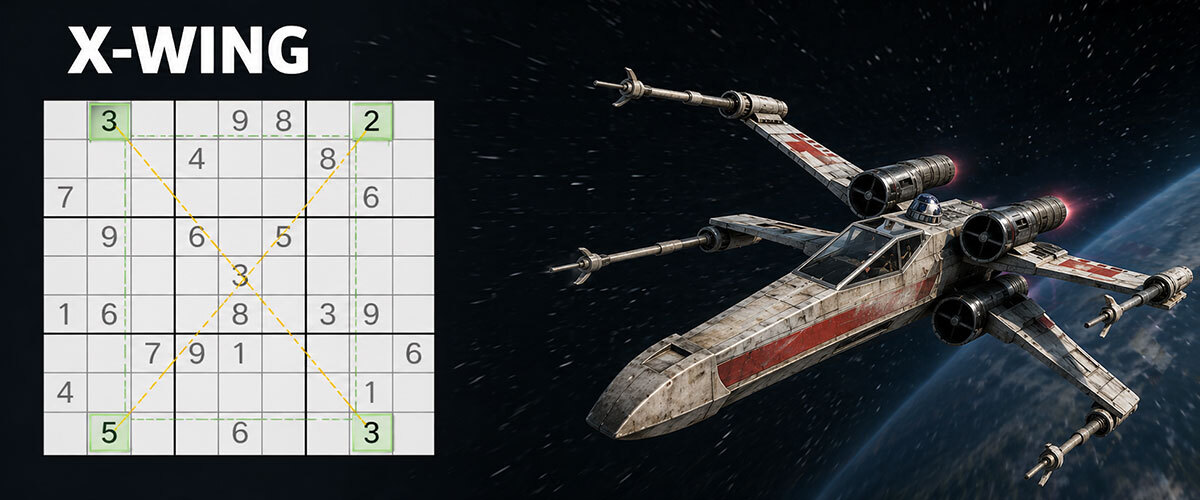
The X-Wing is based on observing the candidates for one number across two rows and two columns. What you’re looking for first is a row where a specific candidate, let’s say 3, can appear in only two cells. Once you’ve found a row like that, check whether there is a second row where 3 can also appear in only two cells. If the candidates for 3 in both rows are in the same columns, you’ve found an X-Wing. The cells with those candidates form a rectangle. If you connect the top-left cell to the bottom-right cell, and the top-right cell to the bottom-left cell with imaginary lines, you get an X, which is where the name X-Wing comes from, along with Star Wars, of course.
The symmetrical shape already gives it away: Whether you look for your candidates in rows, as in this example, or in columns, doesn’t matter. What matters is spotting rectangular candidate constellations.
What Does the X-Wing Do for You?
Let’s say that in rows 2 and 7, the 3 can only go in either column 1 or column 5. The X-Wing doesn’t tell us where the 3 actually goes, but it gives us the key clue that, because of the rectangular candidate constellation, the 3 can only appear in rows 2 and 7 within columns 1 and 5. That means you can remove all other candidates for the number 3 from columns 1 and 5. In this way, you reduce the number of candidates and may find another X-Wing, or, with a little luck, a Single that was hidden before.
Sudoku at Zaphira Games
Want to try out the X-Wing? No problem! Start one of the free Sudoku puzzles at Zaphira Games. With a subscription, you also get access to the “very hard” and “expert” difficulty levels. That’s where the X-Wing becomes especially valuable.
Conclusion
The X-Wing takes a trained eye and patience. Once you master this method, you’ll notice that even the hardest Sudoku puzzles suddenly gain more structure. The X-Wing is not a magic trick, but a logical consequence, and that’s exactly what makes it so fascinating.